They Are Called Jagozes
Jagozes are what they call those born in the village of Ericeira — the “people of the sea”.
Jagozes are what they call those born in the village of Ericeira — the “people of the sea”; those born outside the village are the “people of the land”, belonging to the saloio region, the saloios.
In Ericeira summers, the frequent morning mists are called néuva by fishermen, yet there is always someone in the village who says “it’ll clear today”, and usually by midday it lifts and a radiant sun appears.
For the fisherman, as for most jagozes, there are only two seasons: “berão and imberno. From May to October it is berão; imberno is the remaining months.” (*ª)
In the early nineteenth century, Ericeira’s port was called the “Granary of Estremadura” for the great quantities of grain unloaded there. Records describe a vast array of goods: timber, salt, firewood, coal, vegetables, livestock, meat, furniture, linen and cotton — from here goods were exported to the world, and imports moved on to the rest of the country — the Algarve, the north, Madeira and the Azores. Rascas handled the transport of people and goods: boats twenty metres long, three masts and four sails. The rascas went to Scotland to load manufactured products and to Morocco to load salted fish. In 1818 many jagozes sailed more than five thousand miles in search of a new fortune, to southern Brazil, to what is today the state of Santa Catarina. There they founded the first fishing colony, which they named Nova-Ericeira, now known as Porto Belo.
It is said that at the end of the nineteenth century a Portuguese ship with several crew members had one who was a jagoz. The ship was sailing up the immense Amazon River bound for Manaus, Brazil’s largest river port. During the voyage, already hundreds of miles from the mouth of the river, deep inside the Amazon rainforest, the ship anchored and sent a small boat ashore with some crew, including the jagoz, to gather firewood and fresh water for the vessel. The small boat headed for the bank; in the distance they could only make out the dense curtain of jungle. They landed hoping to find someone who could supply what they needed. The crew disembarked and walked into the forest, and after a few metres came upon a village, entirely isolated. In that village they found a rudimentary brick and tile pottery business, run by an elderly white Portuguese man with a long white beard, accompanied by his two still-young daughters — the man oversaw a group of native Indians working the pottery. It is said that the jagoz crew member addressed the Portuguese owner of the pottery business, and the man barely heard his voice before interrupting him and saying: “You’re from Ericeira.”
Ericeira’s great commercial port died out at the end of the nineteenth century with the arrival of the railway and the Linha do Oeste. The jagoz fisherman sought to earn his living through fishing as best he could. “Out to sea, for lobster, or by line or hook for lighter fishing at the mouth of the Lisandro.” (*ª) In summer some fishermen rented their houses to bathers and lived in the casino, a small storeroom at the back where they kept their fishing gear. They used five-metre boats called lanchas, with one mast, an engine, four oars and a sail called bastarda, rarely used. The lanchas were used for lobster, sole and red snapper fishing.
When the sea is calm or nearly calm, it is immediately seized for lobster fishing, because when the sea grows rough, lobster no longer appears. They go out to sea: the master then knocks on each mate’s door saying: “We’re off, we’ve bait.” Each mate then goes to the tavern keeper to settle accounts (each boat had its tavern where accounts were settled). In those days, the 1930s and 40s, there were about fifty taverns in the village. Then the master or anyone else knocks on the tavern keeper’s door to wake him. He or his wife gets up and settles the men’s accounts.” (*ª)
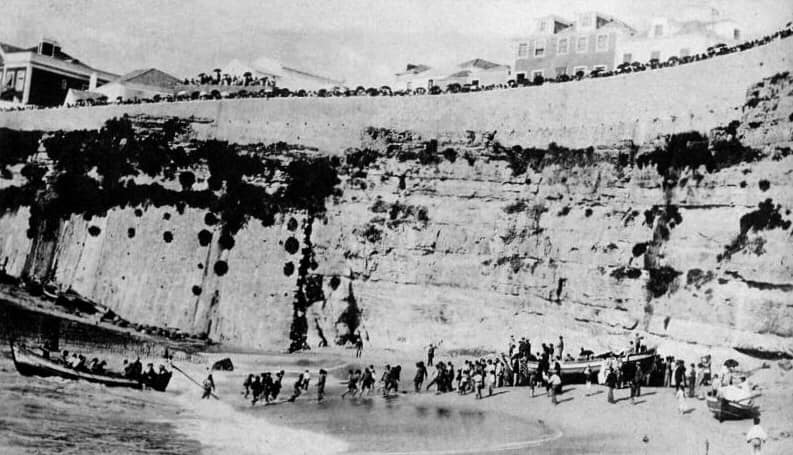
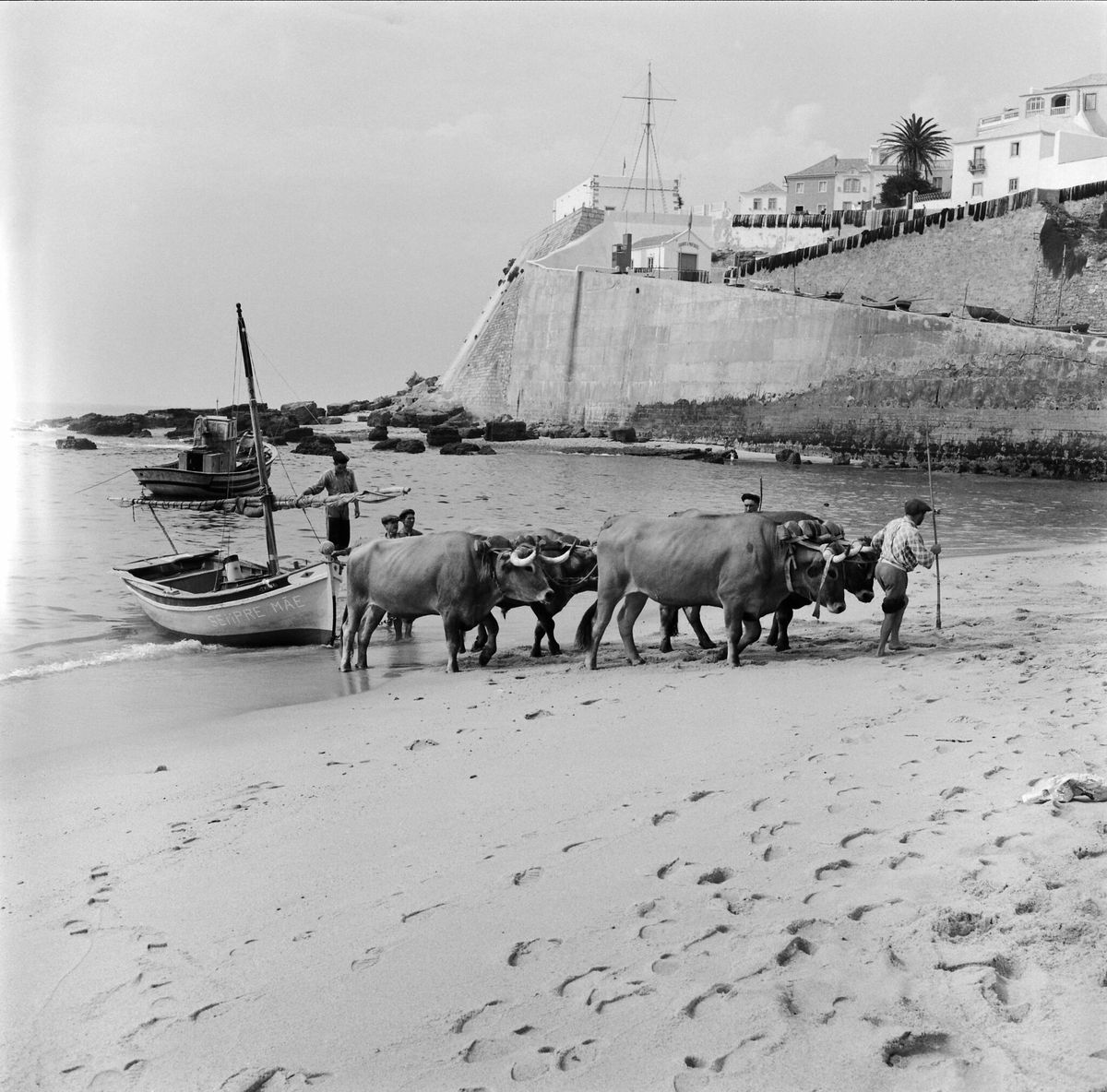
The haul up the beach was done by two oxen, and as the boat engine usually did not start right away, they rowed for a few minutes and the master shouted toc’ àndari. The work lasted two hours. To the rhythm of the master’s command, “Bota p’rá auga”, the traps were thrown into the water. The traps were cages with wire hoops wrapped in cotton mesh netting; the lobster entered, drawn by the bait made of chicharro or horse mackerel, and then could not get out. The traps stayed on the bottom, because as fishermen say, “Lobster is daughter of the deep.” (*ª)
Famous for its lobsters — some said they were the best in the world — it is a fact that lobsters were exported in great quantity to Germany by the airline Lufthansa and by liners leaving Lisbon on regular routes to Brazil, Argentina and Uruguay. To meet this demand, some entrepreneurs, owners of holding tanks, kept lobsters alive until they were shipped. As for spider crabs, in the 1930s and 40s they had no commercial value and were given to the boys who helped on the fish beach (today Praia dos Pescadores) to clean the lanchas after the lobster catch. Those who witnessed it tell of a mother of one of those boys in the streets of Ericeira “throwing one of these spider crabs out the door”, straight onto the stones of the street pavement, shouting that they “used too much firewood” to cook them (*º).
“If the sea seems less lively, hope is reborn — on the next vaia-da-bom, off they go again, to adventure.” (*ª)
(*ª) — Alves, J. (1993) A linguagem dos pescadores da Ericeira
(*º) — Júnior J. (2000) Memórias da Ericeira marítima e piscatório