The Ericeira Brass Band Has Stories to Tell
Scorned by many and respected by others, brass bands remain, across this country, the only music schools in many towns — a place where generations meet and the old pass knowledge to the young.
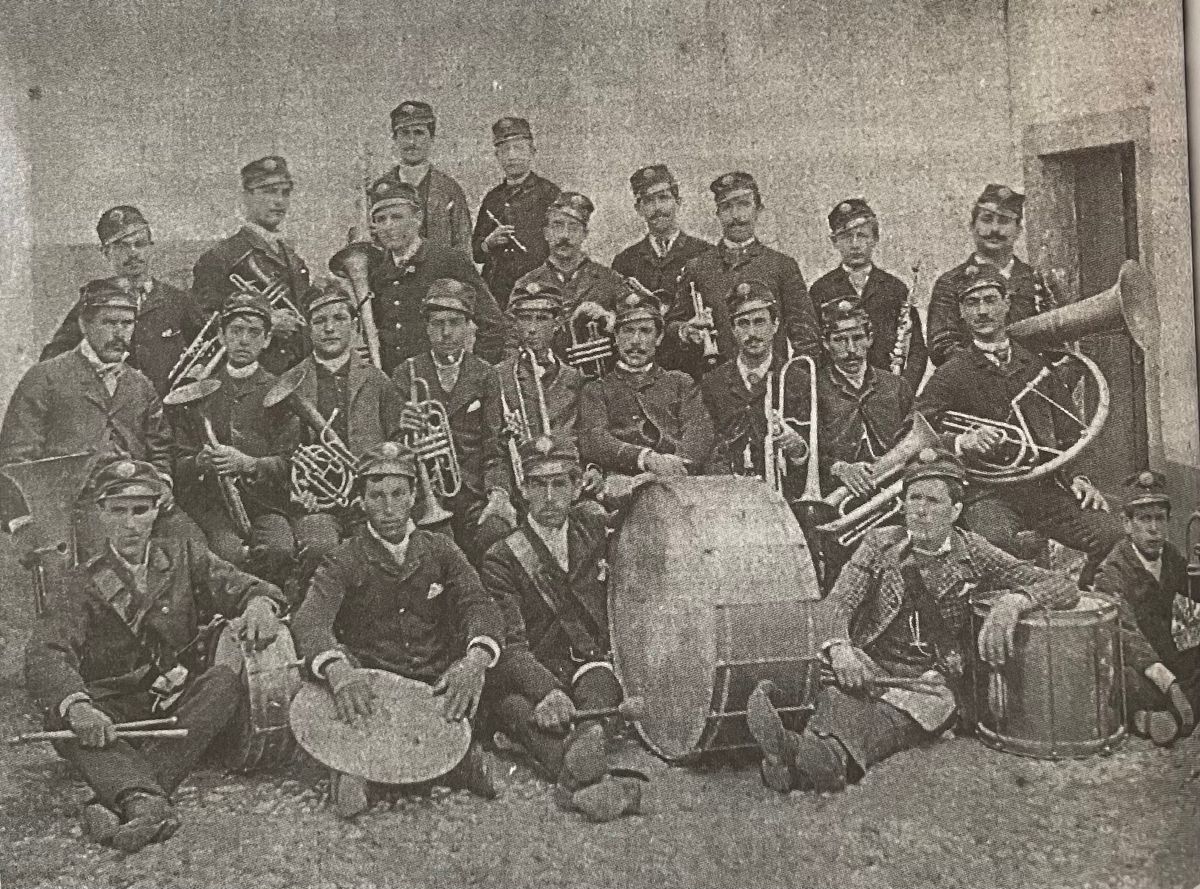
Scorned by many and respected by others, brass bands remain, across this country, the only music schools in many towns — an activity where different generations live side by side and the old pass knowledge to the young.
The Ericeira Brass Band was founded 174 years ago, in August 1849, by a priest, a notary and a teacher (respectively Frei Vicente de São Joaquim Rodrigues Costa, António Agostinho da Costa Batalha and Joaquim Elisiário Ferreira). With no headquarters of its own, rehearsals took place by the light of oil lamps; each musician had to contribute to the cost of oil for lighting, buy their own instrument and uniform. Its long existence is owed to the dedication and persistence of many directors, musicians, patrons and anonymous townspeople.
In those days there were no lorries or vans — you walked to every festival, near or far: Terrugem, 18 kilometres from Ericeira, four hours on foot; Loures, 33 kilometres, roughly seven hours’ stroll; Colares, 22 kilometres, six and a half hours of demanding walking.
“On those walks we had to carry torches which, if it was raining or windy, were torture to light, and when they burned out or would not stay lit they left us in the dark, giving rise to a thousand mishaps on those muddy, rutted paths, making river and stream crossings dangerous, sometimes lost in heath and pine woods, separated from one another, calling to each other with signals made on our instruments so we could regroup and find our way. But no one lost heart. We were all solid lads.” (*1)
If it was winter they returned to Ericeira caked in mud; if summer, white with dust. Merry or worn out, whenever they came back they entered the village streets to the sound of music.
The class of musicians, brass band players or professionals, was, at the start of the twentieth century, a much-maligned class: they were given nicknames, intrigues and lies were spun about them, and the men of the band paid back as they pleased — playing and blowing for hours on end, animating popular festivals. They earned a pittance, haggled over, wept over, and sometimes earned nothing at all.
For the public, a band’s standing grew with the number of performers: fifteen to twenty was a normal band; bands with twenty-five were looked at with respect. The brass bands competed among themselves to see who could play at the most festivals, and the festival organisers took advantage to haggle over fees. “We’ll give 60 mil-réis but we want four voices in the choir.” “Four voices for that money won’t do.” “If it won’t do we’ll go today to Rebaldeira or Torres Vedras!” the organisers would reply. “All right, then 60 mil-réis,” the band would answer. “But it has to be with four voices or nothing doing.” “Don’t worry, the four voices will be there,” the band assured them. On the day of the festival the four voices were in the choir: three sang for real and one was a fake. Other times at the last minute a member fell ill and a substitute had to be hired but the money did not stretch; the band defended itself with clever fakery: they dressed an apprentice in uniform, gave him a wind instrument and put a cork stopper in the tube; the happy lad got to take part in the festivals and the organisers never knew whether he played or pretended to play — they were satisfied because the numbers matched the agreement.
Besides being recreational, the band was also therapeutic. At a village festival or fair what rose fastest was always the wine, and the band’s performance worked as a sedative for the extravagant effects of alcohol. Other times when a quarrel or brawl broke out — quite natural at Portuguese popular festivals — a good brass band conductor would immediately order an attack of a passodoble, a fast rhythm with tense, well-marked beats; the people rushed to the bandstand and interest in the brawl faded and it often died out; other times police intervention was needed.
In 1851 the first copyright law was created in Portugal. A few decades later the question of paying authors’ rights reached the band’s rehearsals. No one knew what it was, but on rehearsal day it was explained clearly. The first to speak was the first trombone, a shoemaker from Ericeira: “I won’t pay a single tostão. When I make a pair of boots I get a hundred mil-réis from the customer, and he doesn’t pay me fifteen tostões every time he puts the boots on.” Everyone agreed with his position and nothing was ever paid. They concluded that such payment would be the responsibility of whoever organised the festivals — the festeiros.
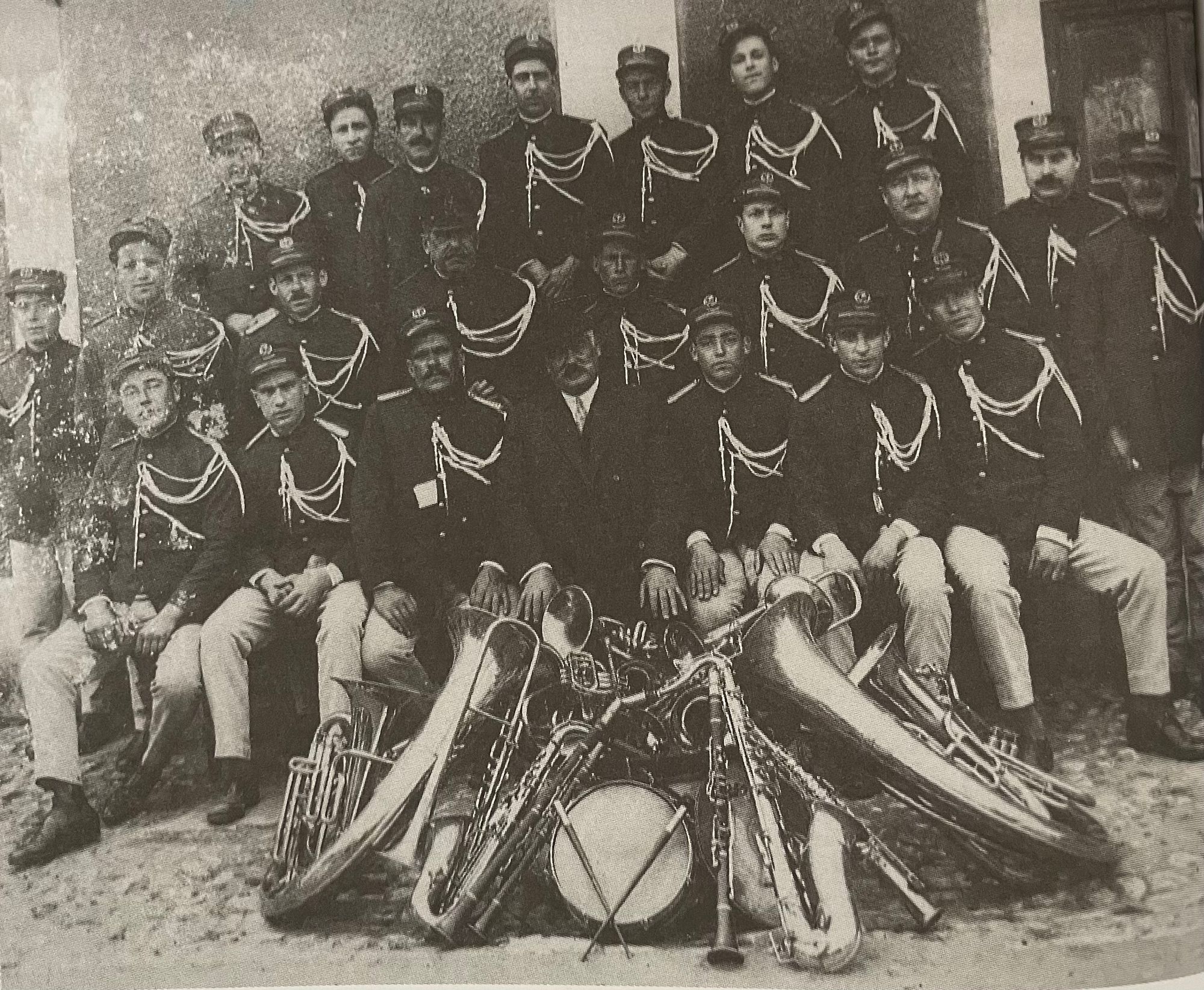
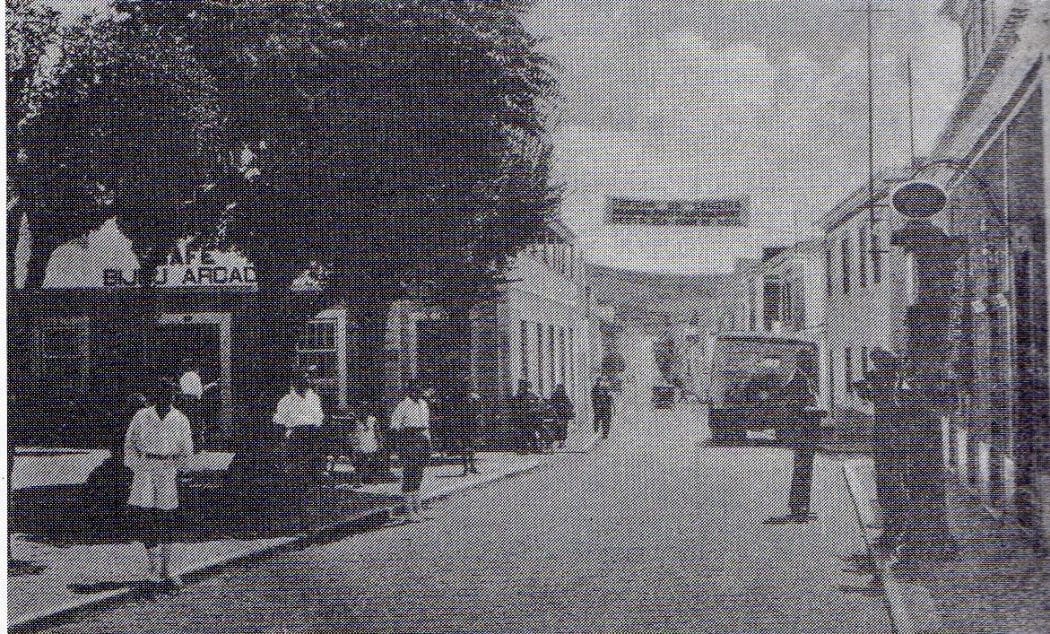
Brass Band in 1930
In 1942, with the development of wireless communications and the spread of radios in homes, a drop was noticed in the number of brass bands — or, as many called it, “live music”. Ears familiar with the band’s repertoire were now dazzled by the musical novelties arriving on distant radio waves. On the other hand, brass band players felt ashamed of not playing with the precision of the professionals the radio broadcast. Though not played with the same accuracy, the truth is that “live music” has another flavour and another presence: fifteen or twenty musicians playing a few metres away, the body vibrates with each chord and the animation is always certain. In many villages the brass band was the only music heard. “Even with small flaws, the band is live music and a source of pride for each neighbourhood.” (*1)
Brass bands still today play an important role in rooting populations by providing musicians and residents with a sense of belonging to their neighbourhoods and their people. They are true centres of learning and citizenship, an important pillar in the formation of many young people.
“To end a brass band takes half an hour. To form a brass band takes years.” (*2)
(*1) Jaime O. L. e S. (1993) A banda da minha terra
(*2) Portugal L. (2004) Ranchos Folclóricos e Bandas Filarmónicas
Photographs: Jaime Lobo e Silva — Memórias de um escrivão, 2016
Text originally published on Ericeiramag.pt
Originally published on Ericeiramag.pt