The Man Lightning Kept Finding
For decades, Roy Sullivan survived things that should have killed him. His story became one of the most improbable of the twentieth century.
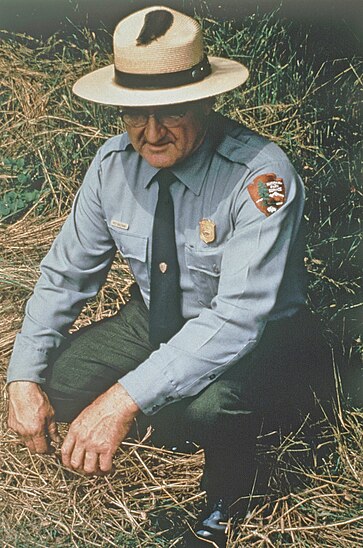
Roy Cleveland Sullivan was born on February 7, 1912, in Greene County, Virginia. He was the fourth of eleven children born to Arthur and Ida Bell Sullivan, a family from the Blue Ridge Mountains. Decades later, when he became a ranger in Shenandoah National Park, he would end up patrolling the same region where he had grown up. He was one of only three rangers responsible for the roughly forty miles between Waynesboro and Swift Run Gap, a landscape he had known since childhood, less than eight miles from his birthplace.
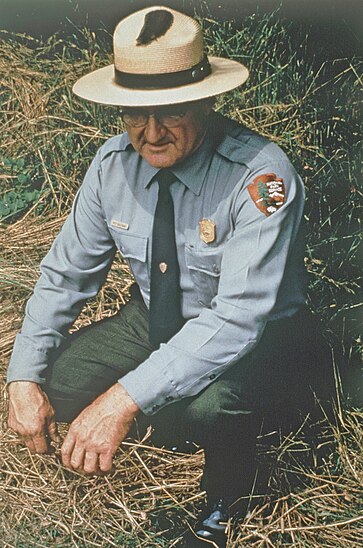
In 1936, at twenty-four, he joined the park ranger service. The work was varied. On one day he might be patrolling trails or helping lost visitors. On another, he might be fighting fires or driving remote roads to check the condition of the park’s infrastructure.
There were no satellites then. No drones. No automatic detection systems. The most effective way to watch for fires was to put a person in a high place and ask him to keep his eyes on the horizon.
For that reason, the park maintained several lookout towers built on the highest points of the mountains. From them, smoke columns could be seen from miles away, and the crews on the ground could be warned quickly.
From time to time, Roy was assigned to lookout shifts, spending hours alone above the trees, exposed to the wind, the rain, and the storms that regularly crossed those mountains.
Decades later, after he had become famous, he would admit to reporters:
“I was always afraid of lightning.”
One afternoon in April 1942, Roy Sullivan was on duty in one of Shenandoah National Park’s lookout towers. It was routine work and, up to a point, monotonous: hours spent watching the horizon and hoping nothing happened.
In the distance, a storm began to form. The clouds darkened the sky, the wind strengthened, and the first thunderclaps rolled across the mountains. Roy had seen countless thunderstorms over the course of his career, but one detail made that situation especially dangerous: the tower he was in had no lightning rod.
Soon after, lightning struck the structure. Then another bolt. And then another. With each discharge, the tower shook. The place built to protect the forest now seemed like a trap suspended above the trees.
Roy decided to leave the tower. He hurried down the stairs and ran to get away from the structure. He did not get far. A bolt of lightning struck him, and the current travelled down his right leg and out through his foot. The impact tore the nail from his big toe and left him stunned.
He survived the accident and recovered from his injuries. For many years he would remember that episode as the worst lightning strike of his life. At that moment, however, he had no way of knowing it. For anyone else, surviving a lightning strike would have been an extraordinary story to tell friends and family.
For Roy Sullivan, it was only the first.
Roy kept working in Shenandoah National Park. The 1942 episode became one of those improbable stories occasionally told to colleagues or friends. He had survived lightning. It was rare, but not unheard of. Life went on.
Until July 1969.
That day, Roy was driving a truck along a park road when a storm formed over the mountains. He was protected inside the vehicle, a place most people would consider safe during a thunderstorm. Then lightning struck the truck.
The charge entered through the open window, crossed the inside of the vehicle, and hit Roy. The impact knocked him unconscious for a few moments. When he came to, his eyebrows were gone and his hair was on fire.
He managed to stop the vehicle and put out the flames before the injuries became more serious. It was the second time lightning had struck him.
This time, though, a strange idea began to appear. A coincidence stops feeling like a coincidence when it happens twice.
Roy kept the hat he had been wearing that day. Later he would keep another. And then another. Over the years, he would assemble an unlikely collection: hats burned by the lightning strikes he had survived.
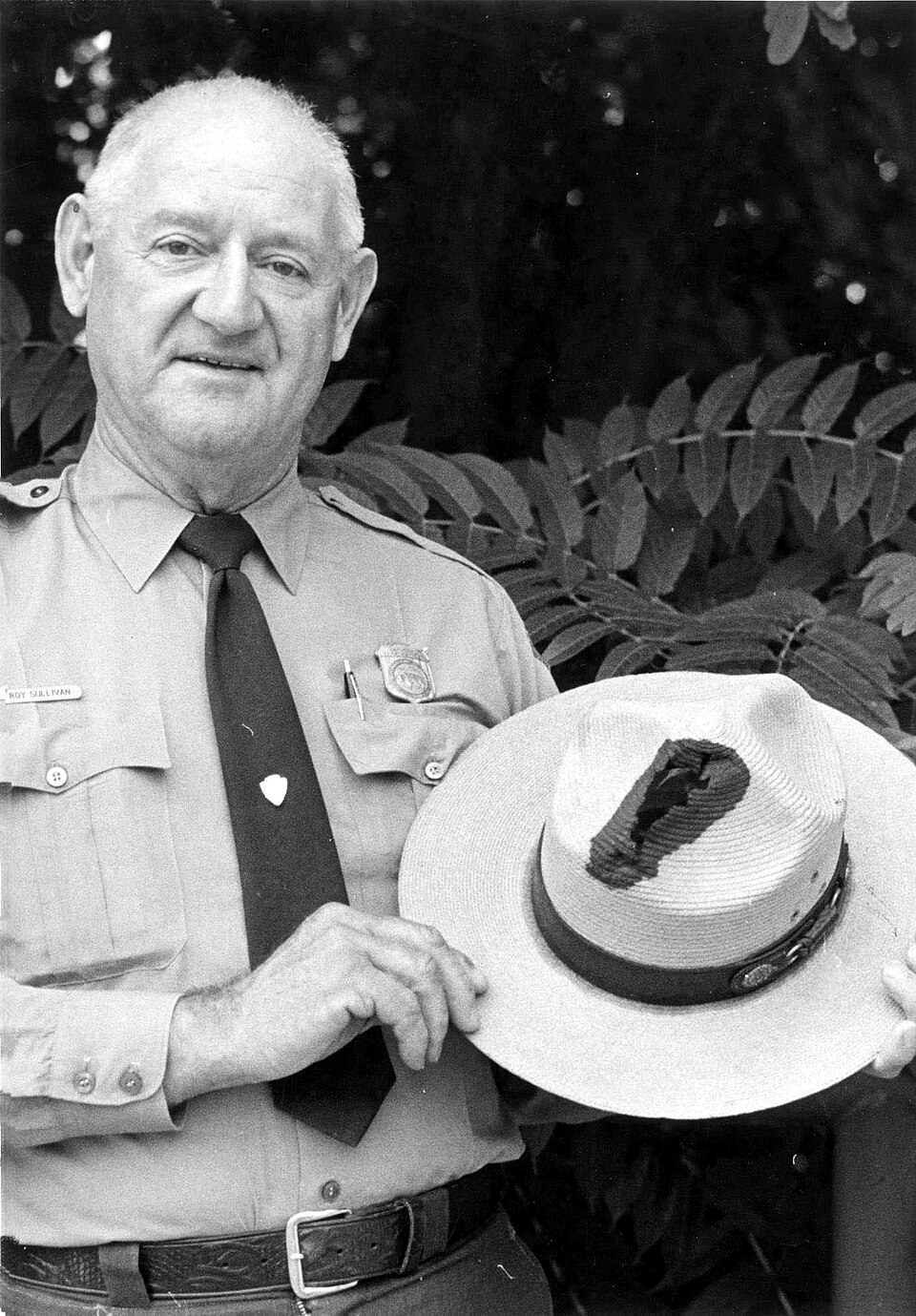
Maybe it was a way of laughing at the situation. Maybe it was simply a way to prove to himself that it had really happened.
If the second strike had been an extraordinary coincidence, what followed began to look like something else.
Less than a year later, in July 1970, Roy was in his yard at home when a storm approached. He was no longer the ranger who had survived one rare accident. He was a man who had been hit by lightning twice and who now watched the sky with growing attention.
The storm came closer. So did the lightning.
The discharge hit him again, burning his left shoulder. Roy survived once more, but the idea that all of this could be merely bad luck was becoming difficult to sustain.
Two years later, in 1972, it happened again.
This time he was on duty in the park when lightning struck him on the head.
He would later describe the moment:
There was a light rain, but no thunder until one single clap, the loudest thing I ever heard. Fire was jumping around inside the ranger station, and when my ears stopped ringing, I heard something sizzling. It was my hair burning.
Roy managed to put out the flames, but the episode changed one of his habits. From then on, he began carrying a container of water in his vehicle. It was not for drinking, and it was not for mechanical emergencies. It was to put out his own hair in case he was struck again.
His colleagues began to look at him differently. Some joked about it. Others preferred to keep their distance during thunderstorms. Roy himself would later remember one revealing episode. One day he was walking with the chief ranger when lightning fell in the distance. The chief looked at the sky, looked at Roy, and said goodbye:
“I’ll see you later.”
The sentence stayed with him.
His fame spread through the park. Among the rangers, a kind of unwritten rule even emerged. Years later, his colleague Robert Jacobsen summed it up for a journalist:
“If you see a dark cloud coming your way, get away from Roy Sullivan.”
Some people spoke of a curse. And then there was Roy, who was beginning to have doubts of his own.
Years later he would say that sometimes he saw a cloud approaching and felt as if it were coming after him. It sounded absurd. He knew that. But after four lightning strikes, absurdity was beginning to seem as reasonable an explanation as any.
In August 1973, Roy was patrolling a road in Shenandoah National Park when he noticed a dark cloud forming over one of the mountains. It was not a storm that filled the horizon, nor a particularly impressive weather front. According to his account, it was a single isolated cloud.
When he saw it, he felt immediate unease. In the previous four years, he had already been hit by lightning four times. Enough for a simple storm cloud to stop being only a cloud. He got into the truck and decided to drive away.
As he drove, he kept looking in the rearview mirror. Later he would say he had the feeling the cloud was following him. He changed direction. He accelerated. He kept driving. But the feeling did not go away.
Then the lightning fell.
The discharge hit him and set his hair on fire again. Roy managed to stop the truck and get out onto the road. He had with him a container of water, a habit acquired after the previous incidents. He used it to put out the flames before the injuries became more serious.
Years later, whenever he remembered that episode, he insisted on the same version of events. He said that cloud had followed him. It is a difficult claim to accept. But it is also difficult to accept that the same man was struck by lightning five times in just over thirty years.
By then, Roy Sullivan’s story was beginning to exceed the limits of what seemed reasonable. Even to him.
In 1976, it happened again.
Roy was in the park when lightning struck him in the ankle. He survived, as he always had. The news no longer surprised his colleagues quite as much. By then, the man who seemed to attract lightning was a known figure inside and outside Shenandoah.
Less than a year later, in June 1977, came the seventh incident. This time the discharge struck his chest and stomach. Once again, he escaped with his life.
Seven lightning strikes.
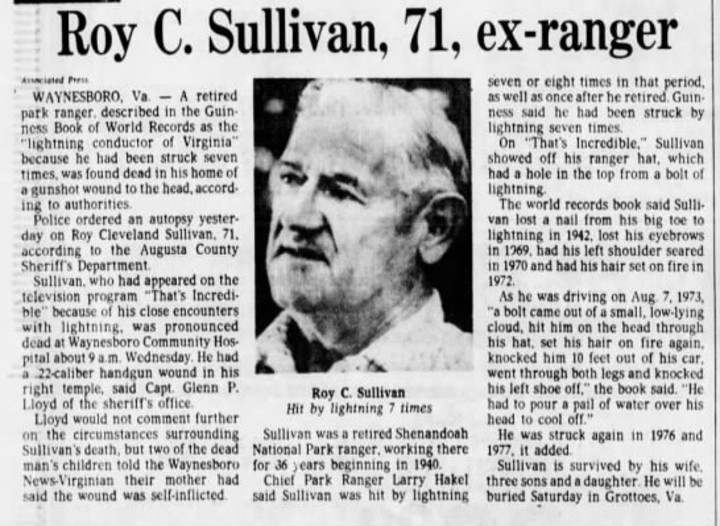
Even meteorologists found the sequence of accidents hard to understand. For years, estimates circulated about the probability of someone being struck so many times. The numbers varied according to the calculation, but they all pointed to the same conclusion: this was an extraordinarily improbable event.
In 1972, when he had already been hit four times, Guinness World Records listed him as “the only living man struck by lightning four times.” The notoriety brought interviews, television appearances, and even a spot on the American game show “To Tell the Truth.” Later, he would be interviewed by David Frost.
Curiously, only the first four lightning strikes were formally documented and submitted to Guinness. The last three were based mostly on Roy’s own accounts. Some skeptics questioned them. Others answered with a simple question: why would someone who had already survived four lightning strikes invent three more?
Fame came late in his life, and in a form no one would wish for. Roy began to be photographed beside the burned hats he had kept over the years. In some images, he holds them like trophies. In others, he simply looks tired.
After all, most celebrities are known for something they tried to achieve. Roy became famous for repeatedly surviving something he spent his whole life trying to avoid.
Lightning made Roy Sullivan famous, but it was not the only danger he dealt with in the Shenandoah mountains.
Over the course of his career as a ranger, he claimed to have had at least twenty-two encounters with black bears. Most people could live an entire lifetime without coming face to face with a single wild bear. Roy seemed to find them with unusual frequency.
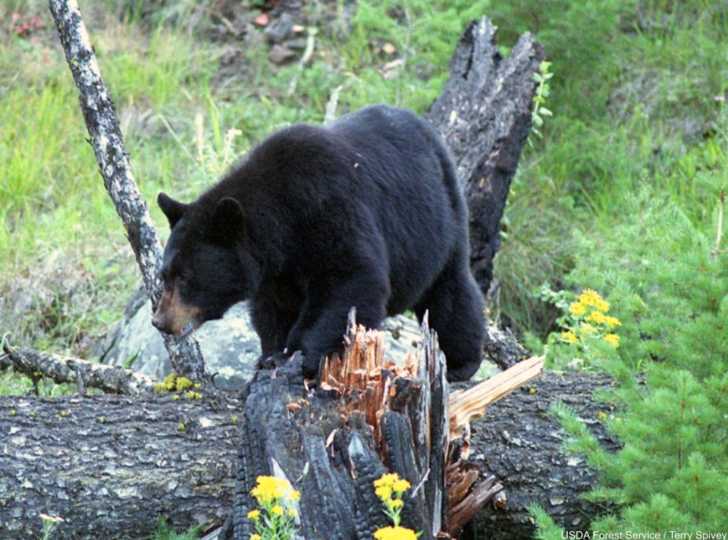
On one occasion, he said he had driven off a bear using a tree branch. In others, he described encounters that ended in chases, threats, and physical confrontations. It is difficult to verify each of those stories individually, but they appear again and again beside his name and help explain the environment in which he spent much of his life: isolated mountains, dense forests, and animals that could become dangerous when surprised or cornered.
Roy particularly liked this part of his story. Perhaps because bears were an opponent easier to understand than lightning. A bear can attack, retreat, or run. There is a logic to its behavior. Lightning was different.
At one point he even claimed:
“I believe I am the person who has fought bears the most times and survived.”
There is no record that anyone ever confirmed the claim. But after hearing the story of the seven lightning strikes, few people seemed inclined to argue statistics with Roy Sullivan.
Whatever the case, there is something revealing in that detail. The man who entered Guinness for surviving seven lightning strikes did not spend his life hiding from danger. He kept walking through the same mountains, doing the same work, and facing the same risks he always had.
By the early 1980s, Roy Sullivan was retired. He moved to Dooms with his fourth wife and took a curious precaution. He had several lightning rods installed on the property. After a lifetime spent fleeing storms, he finally wanted to feel safe at home.
The man who had survived seven lightning strikes had become a national curiosity. His name appeared in newspapers, record books, and television programs. People who had never heard of Shenandoah National Park knew his story.
But fame rarely shows a person’s whole life.
The articles talked about the lightning, the burned hats, and the almost impossible odds of someone surviving so many accidents. They said little about the man behind the story. They said even less about the loneliness that can follow retirement after decades spent in demanding work outdoors.
It was during that period that Roy fell in love with a woman.
The details have largely been lost to time. What reached the newspapers after his death was the description of a man deeply affected by a relationship that did not develop as he had hoped. Friends and people close to him said he was emotionally shaken.
It is hard to know exactly what he felt. What we know is that, at that stage of life, Roy was facing a problem for which there were no statistics, no weather forecasts, no containers of water to put out flames.
For decades, he had survived events that kill other people instantly. He had faced lightning, storms, fires, and even bears. Yet, as happens to so many human beings, he discovered that there are wounds against which physical courage offers little protection.
Roy had spent years trying to protect himself. He had installed lightning rods at home. He avoided storms whenever he could. And yet the seventh lightning strike had hit him far from there, while he was fishing.
None of those precautions mattered in the early hours of September 28, 1983.
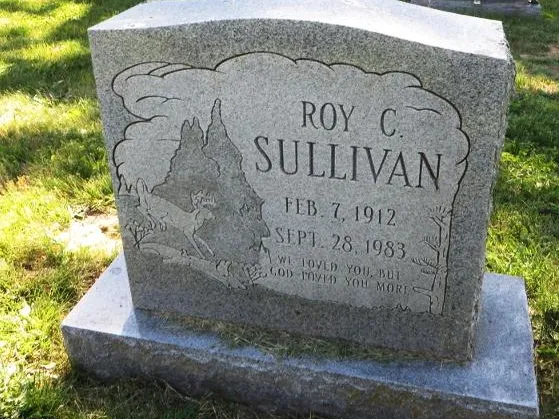
Roy Sullivan died at the age of seventy-one.
The official cause of death was suicide. He used a firearm. According to the investigation, the shot occurred at around three in the morning. His wife was asleep beside him and did not wake. His death would only be reported hours later.
The newspapers that covered the case said he had been going through a difficult period and linked his death to heartbreak. As often happens in these situations, the exact details have largely disappeared with time. What remains are the essential facts and the memories of those who knew him.
The news surprised many of those who had followed his story. For decades, Roy had seemed to defy probability. He had survived the seven lightning strikes for which he became known, fought forest fires, spent much of his life in isolated mountains, and claimed to have survived more than twenty encounters with bears.
It was easy to look at him as someone invincible.
But life rarely respects the stories we build around people.
When the news of his death reached the papers, many articles remembered the lightning. It was inevitable. Lightning had made him famous. Even today, decades later, Roy Sullivan’s name remains attached to a record that will be hard to surpass.
And yet perhaps his story says less about lightning than about something else.
Even the people who seem to survive everything are still human.